Reading Guides

Updated: Jul 29
I created supplemental materials to go along with some of the early readings in my lower-level philosophy classes. As introductory philosophy classrooms are where many students encounter this material formally for the first time, I find offering supplemental materials which help guide the students to key points in the reading help break the reading into more manageable steps.
Initially I used the reading guides as take-home homework, to be turned in for points. But with the rise of LLMs and chatbots, the reading guides have proven more efficacious in-class than out-of-class. I found that if given the guides in-class, the students can use them to organize their notes and questions they may have about the reading, whereas out-of-class students were more often filling them out via chatbots (and producing quite a bit of nonsense while side-stepping the purpose of the guides altogether).
I do not know if I will continue utilizing the reading guides in the future, or if perhaps they will continue on in a different form (the Plato's cave drawing activity proves much more fun to do in class, where I can prevent the students from looking up pictures of the cave online. The images they come up with from the reading vary much more widely than the ones they produce when they have access to the internet).
Plato's Symposium
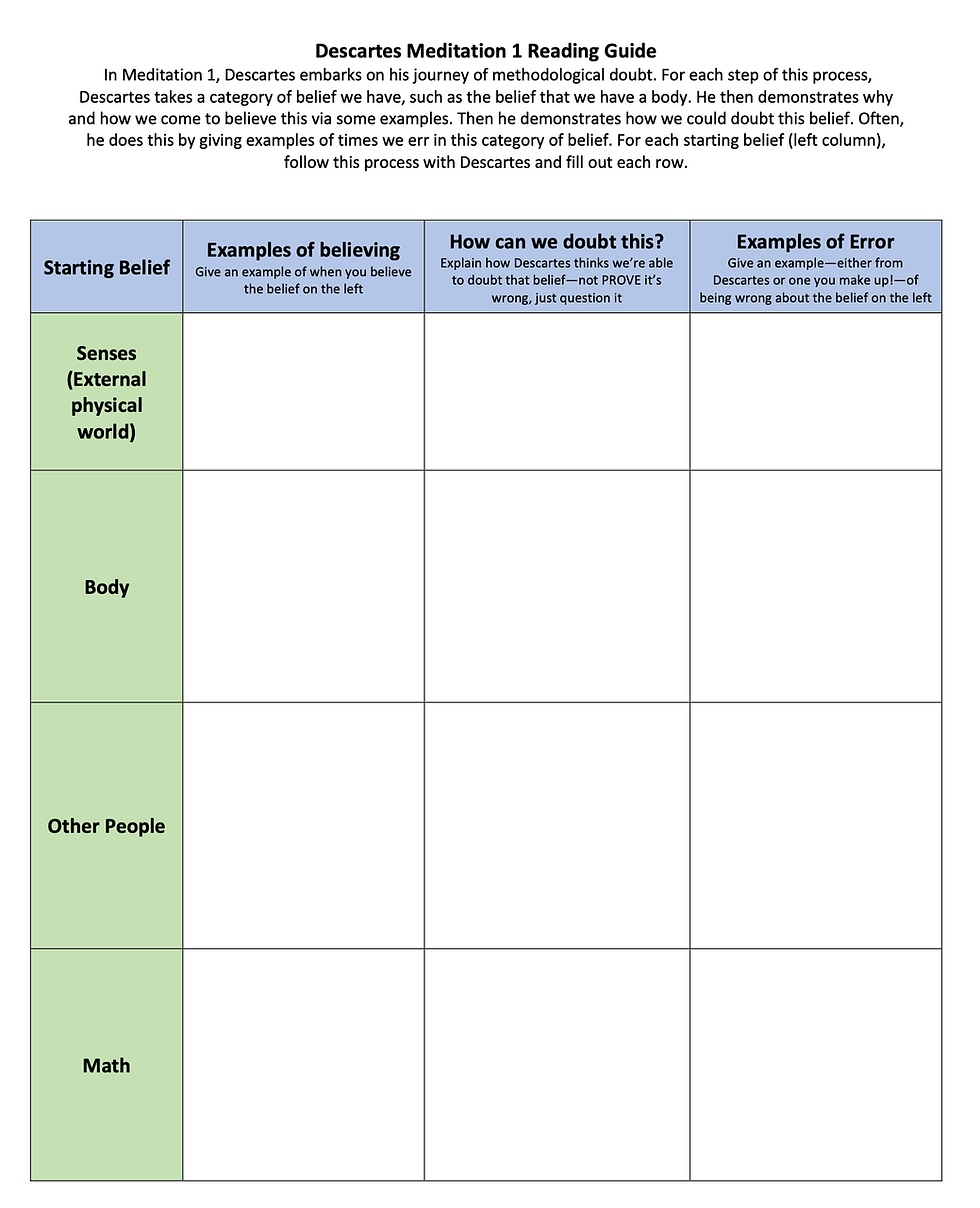
Descartes' Meditations (Book I)
Aristotle's Nicomachean Ethics (Book I)
Plato's Allegory of the Cave (Republic Book VII)
Pre-Socratics
(I use this same reading guide for all the pre-Socratic philosophers we study in my Ancient Philosophy course. Some pre-Socratics it fits better than others, but for those it does not fit (Diogenes the Cynic, for instance), it is an interesting exercise to see how the students react to trying to force some philosophers into the same box as the others


Comments